Artificial Turf in Arizona: What to Know Before You Install
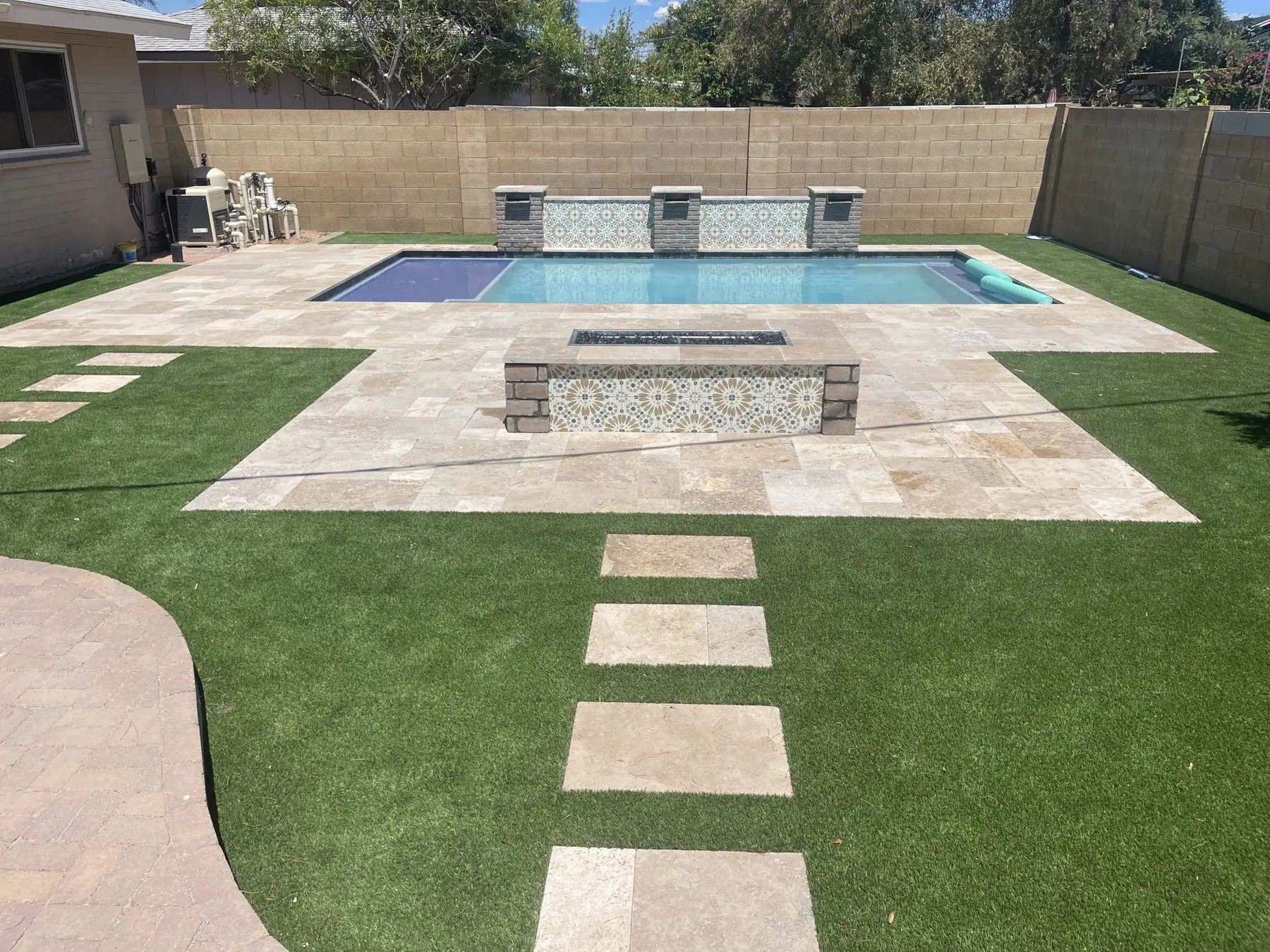
Artificial turf makes a great deal of sense in Phoenix. Natural grass here demands significant water through a brutal summer, overseeding every fall, and constant mowing — and it still struggles in the hottest exposures. Turf eliminates all of that. But turf installations vary enormously in quality, and the failures are consistent and predictable. Here's what actually matters.
The Base Is the Whole Job
If you take one thing from this article: the turf itself is the smaller half of the decision. What determines whether an installation looks good in year eight is the base beneath it.
A proper installation means excavating to adequate depth, installing a free-draining aggregate base, compacting it in lifts, and grading it so water moves where you want it. A poor installation lays turf over thin, uncompacted material or existing soil. The results show up within a couple of seasons: low spots that hold water, visible wrinkles, seams that separate, and edges that lift.
Yes, It Gets Hot
Any installer who tells you turf stays cool in Arizona sun is not being straight with you. Synthetic fibers in full summer sun get hot — hotter than natural grass, which cools itself through transpiration. This is a real limitation and worth planning around rather than ignoring.
What genuinely helps: placing turf where it gets afternoon shade from a tree or structure, choosing lighter-colored infill, and rinsing the surface before use on a hot day, which drops the temperature substantially for a while. Turf under a ramada or on the east side of the house stays comfortable. Turf in a full west exposure will be hot in July regardless of what you buy.
Pets Need the Right Build
Turf works well for dogs, but only with the right specification. Pet-grade turf uses a fully permeable backing so urine passes straight through instead of pooling in the backing. Underneath it needs the same free-draining base, and the infill should be one of the zeolite or antimicrobial-coated products that manage odor rather than trapping it.
With that build, maintenance is periodic rinsing. With a non-permeable backing or a poorly draining base, you will have an odor problem that no amount of cleaning fully solves.
Drainage and Monsoons
A correctly built turf area drains faster than the natural grass it replaced. The permeable backing passes water and the aggregate base moves it away. The failure mode is a base that was never graded — water pools, the area stays soggy, and the base slowly deforms. Ask specifically how the installer plans to handle drainage and where the water is going to go.
Turf Quality Varies Widely
Face weight, blade shape, UV stabilization, and backing construction all differ substantially between products, and the cheap end of the market does not survive Arizona UV. A quality UV-stabilized turf on a proper base commonly gives fifteen years or more here. An inexpensive product on a poor base can look visibly bad in three.
Ask to see samples in your own yard, in daylight. Turf reads very differently under showroom lighting than it does in Arizona sun.
What Maintenance Actually Looks Like
Turf is low-maintenance, not no-maintenance. Expect to rinse it occasionally, brush high-traffic lanes to stand the blades back up, blow or rake off leaf debris, and top up infill every several years in heavily used areas. That's a small fraction of what natural grass demands here, but it isn't zero.

AZ Outdoor Concepts
Phoenix's outdoor living, hardscape, and landscape contractor. A small, family-owned business led by Shawn Walker with over 18 years of experience turning ordinary Arizona backyards into shaded, usable, year-round living space.
Related Services
Planning a artificial turf project?
Get a free consultation and estimate from the Phoenix area's trusted outdoor living, hardscape, and landscape contractor.